Most organisations do not have a data shortage. They have a truth shortage.
This is due to their technology stack, which records interactions across media, content, webinars, intent data and sales conversations. Yet when executives ask which investments created pipeline or accelerated opportunities, the answer often turns into a debate over dashboards.
For instance, research reports that 40.8% of US marketing leaders identify measuring ROI as their leading challenge, compared with 33% globally.
Hence, the pressure is to connect digital activity to buyer outcomes credibly.
Attribution Is Evidence, Not a Verdict
Attribution models deliver the most value when viewed as informed guidance rather than absolute truth.
For instance, first-touch attribution explains discovery. Deal-creation attribution highlights opportunity formation. Multi-touch attribution distributes credit across the journey. Revenue attribution connects activity with closed-won value.
Each attribution provides a useful view; however, none reconstructs the buyer’s decision process.
A recent study separates contact creation, deal creation and revenue attribution while allowing teams to compare models. Therefore, attribution models operate as a set of analytical lenses, and not a single scoreboard.
This matters as buying behaviour moves beyond clicks.
Moreover, studies report that 90% of marketing leaders serving business buyers consider visibility in AI-generated answers to be at least an investment-level priority.
It also found that eight of the 12 leading criteria used to judge marketing depend on proving direct engagement. Therefore, as buyers research through answer engines and less visible digital journeys, engagement-based measurement captures a smaller share of influence.

Build a Signal-to-Revenue Chain
Downloads, intent signals and opportunities each contribute valuable insight, but meaningful attribution comes from understanding how they connect.
Hence, reliable measurement requires a traceable chain, such as:
- Digital Interaction
- Account engagement
- Buying-group activity
- Qualified Progression
- Opportunity Movement
- Buyer Outcome
As a result, this changes the question from “How many leads did this generate?” to whether the programme reached the right accounts, expanded buying-group coverage, improved qualification or shortened sales cycles.
Moreover, it exposes misleading efficiency.
For instance, a channel can generate inexpensive responses but deliver low-fit accounts. A webinar can attract fewer registrations while influencing high-value opportunities. Content syndication may look weaker through first-touch reporting yet prove valuable when measured against account penetration and pipeline progression.
Therefore, measurement must differentiate between activity that simply increases volume, such as clicks, downloads or registrations, and engagement that changes buyer behaviour, such as broader account participation, stronger buying intent or measurable opportunity progression.
The Business Intelligence Platform as a Decision Layer
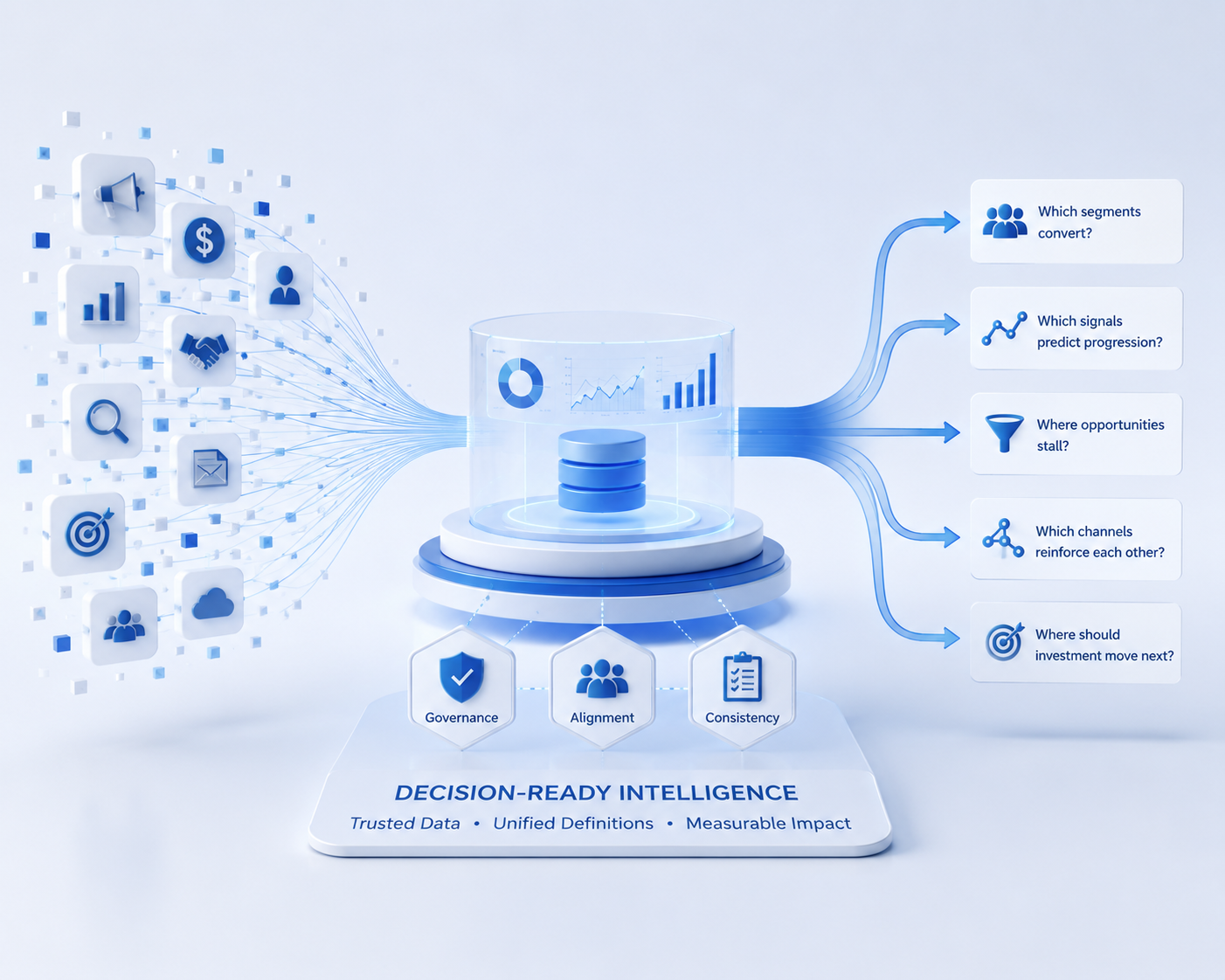
A business intelligence platform should not merely visualise disconnected data; it should also reconcile it.
For example, campaign costs, CRM stages, account hierarchies, intent signals, content engagement, opportunity values and closed revenue must sit within a shared measurement environment. Furthermore, definitions also need governance, because when marketing, sales and finance interpret “qualified”, “influenced” or “sourced” differently, no dashboard can produce trusted ROI.
Moreover, value lies in decision-ready intelligence: which segments convert, which signals predict progression, where opportunities stall, which channels reinforce one another and where investment should move next.
For instance, a 2026 forecasting guidance states that 73% of marketers face increased budget scrutiny, while 75% operate across five or more channels.
Hence, fragmented reporting can direct budget towards visible activity rather than meaningful contribution.
Measure Incrementality, Velocity and Quality
Attribution tells you where credit is assigned. However, incrementality asks whether the outcome would have happened without the investment.
As a result, stronger measurement combines attribution with controlled tests, matched-account comparisons, holdout groups and pre- and post-programme analysis.
Furthermore, it also evaluates more than volume.
For instance, pipeline quality shows whether activity creates relevant opportunities. Velocity reveals whether engagement moves deals faster. Conversion analysis identifies where demand loses momentum. Deal value and win rate indicate whether programmes influence stronger revenue potential.
Moreover, a 2026 CMO Spend Survey found that marketing budgets remain effectively flat at 7.8% of company revenue, while 56% of CMOs say they lack the budget needed to execute their strategy.
Therefore, measurement must help leaders stop funding activity that looks productive but does not change outcomes.
Turn ROI into a Continuous Operating System
The traditional model measured ROI after a campaign ended. However, the stronger model uses performance intelligence while demand is still developing.
Studies argue that future marketing capability will connect insight, personalisation, execution and orchestration within a continuously improving system.
As a result, measurement closes that loop, allowing teams to refine targeting, messaging, channel mix and sales coordination before the pipeline is lost.

The Acumen Intelligence Advantage
At Acumen Intelligence, we help technology organisations connect data-driven demand generation, account-based programmes, intent intelligence, content syndication, events and display activity with clearer buyer intelligence measurement.
By combining access to millions of global decision-makers with targeted programme execution, we support clients in moving beyond surface-level engagement and focus on account relevance, lead quality, pipeline progression and measurable revenue impact.
The organisations gaining the greatest advantage will not be those collecting the most data. They will be those capable of deciding which evidence deserves investment.
Connect with the Acumen Intelligence Business Development team to build data-driven demand programmes that turn buyer signals into stronger attribution, clearer pipeline decisions and accountable revenue growth.