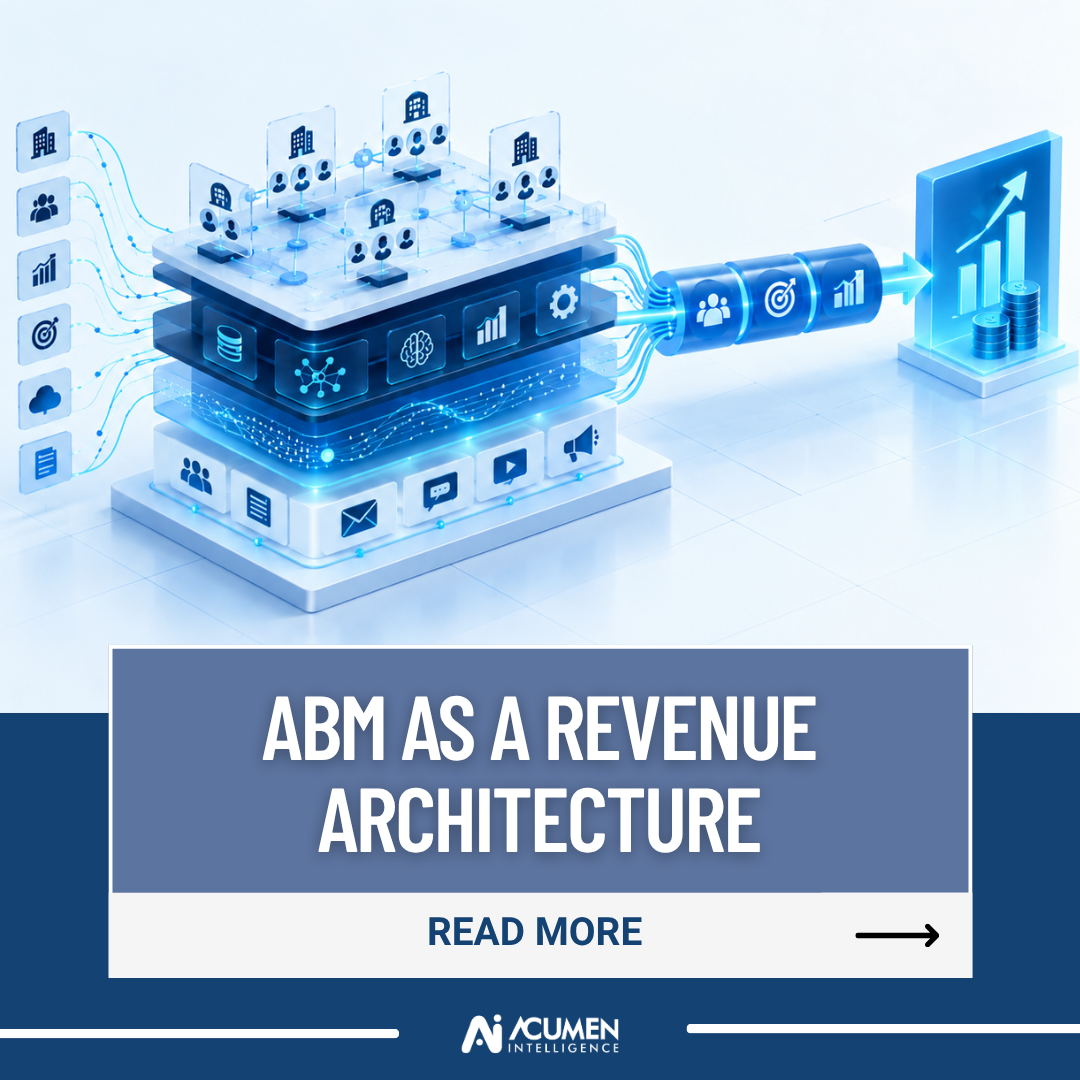
Fragmented data does more than slow teams down.
It weakens the intelligence behind targeting, AI, attribution and revenue decisions.
Revenue growth is increasingly powered by data.
For instance, account intelligence informs targeting. Intent signals help identify active demand. CRM activity shapes prioritisation. Campaign engagement influences nurture paths, and AI is beginning to interpret and act on this information.
However, much of that data still lives in disconnected systems.
A contact may appear one way in a CRM, another in a marketing automation platform and as something else inside an intent-data or analytics environment.
Each system may function correctly, yet together they can produce an incomplete version of the buyer.
Therefore, this is why fragmented data is becoming less of an IT inconvenience and more of a revenue risk.
When More Data Creates Less Clarity
Most organisations are not suffering from a shortage of data. They are struggling to connect it.
For instance, 2026 research found that only 65% of marketers say they have high-quality audience data. It also found that 12.4% cite difficulty sharing data across their organisation as a major challenge, while 19.5% struggle with adopting a data-driven marketing strategy.
Hence, the challenge can become serious when disconnected datasets guide commercial decisions.
Moreover, consider a target account researching a priority topic, engaging with syndicated content and repeatedly visiting product pages. If those signals sit across separate platforms, the organisation may never recognise the combined pattern.
For instance, one team sees web traffic. Another sees an engaged contact. Sales sees an account with limited CRM activity.
Therefore, the opportunity exists, but the revenue system cannot see it.
Hence, fragmentation creates something more dangerous than missing data: missing context.
One Buyer, Multiple Versions of the Truth
Modern go-to-market execution depends on teams making decisions from a shared view of accounts, buyers and engagement.
Yet systems often contain different definitions, identities and ownership rules.
Furthermore, recent studies highlighted this challenge in 2026, noting that many organisations can point to sophisticated data lakes and warehouses while still struggling to answer basic questions such as who owns customer data or where the authoritative revenue number sits.
Hence, when those questions remain unresolved, downstream execution becomes inconsistent.
As a result, marketing may optimise towards engagement that sales cannot see.
Sales may deprioritise accounts demonstrating intent elsewhere. Revenue leaders may compare reports built from different definitions of pipeline or influence.
Ultimately, the result is decision-making built on competing versions of reality.
AI Is Only as Strong as the Data Behind It
This becomes even more consequential as AI moves deeper into revenue operations.
Studies report that lack of data readiness is a leading barrier to AI, prompting more than 75% of organisations to prioritise investment in AI-ready data.
Additionally, further studies also found that organisations reporting successful AI initiatives invest up to four times more in foundational areas such as data quality, governance and AI-ready capabilities than organisations experiencing poor outcomes.
Extensive research on AI data readiness reaches a similar conclusion, noting that more than two-thirds of high-performing companies identified data as the primary obstacle to enabling AI.
AI does not repair fragmented commercial context by itself. It scales whatever context it receives.
Hence, if account records are duplicated, definitions conflict or engagement signals remain inaccessible, AI can produce faster answers without necessarily producing better ones.
However, as agentic systems take actions across workflows, weak foundations can turn isolated inconsistencies into automated mistakes.
Therefore, AI-ready data needs to be connected, governed, traceable and usable in context.
Data Integration Is Now a Revenue Capability
The organisations that solve fragmentation will gain more than cleaner dashboards.
For instance, connected data makes it possible to recognise buying-group activity across channels, combine account fit with behavioural signals, improve lead prioritisation and measure revenue progression with greater confidence.
Furthermore, studies found that organisations with the highest maturity in AI-ready data and analytics capabilities achieve up to 65% greater business outcomes, including revenue growth and cost optimisation.
That creates the strategic shift that data integration should no longer be treated purely as infrastructure expenditure. It is part of the architecture determining how effectively an organisation can identify, interpret and activate demand.
Therefore, for revenue teams, the question is no longer:
“How much data do we have?”
It is:
“Can our systems turn that data into one coherent commercial signal?”
The Acumen Intelligence Advantage
Data-driven demand generation works best when account intelligence, buyer signals and engagement data come together to reveal where genuine commercial opportunity is building.
Acumen Intelligence helps organisations turn those signals into action by identifying relevant decision-makers, activating demand across the right channels and creating clearer pathways from digital engagement to qualified pipeline.
With data-driven audience intelligence and integrated demand-generation capabilities, Acumen helps revenue teams move beyond isolated campaign activity towards more precise, measurable growth.
Connect with the Acumen Intelligence Business Development team to explore how a more connected approach to demand generation can turn fragmented signals into stronger revenue opportunities.