The Revenue Stack Is No Longer a Toolset, It Is an Intelligence System
The modern enterprise revenue engine cannot rely on disconnected campaigns, separate CRM records, isolated lead lists or manual marketing-to-sales handovers. In a digital buying environment shaped by account-level behaviour, intent signals and multi-stakeholder decisions, growth depends on how intelligently data, demand and deals are connected.
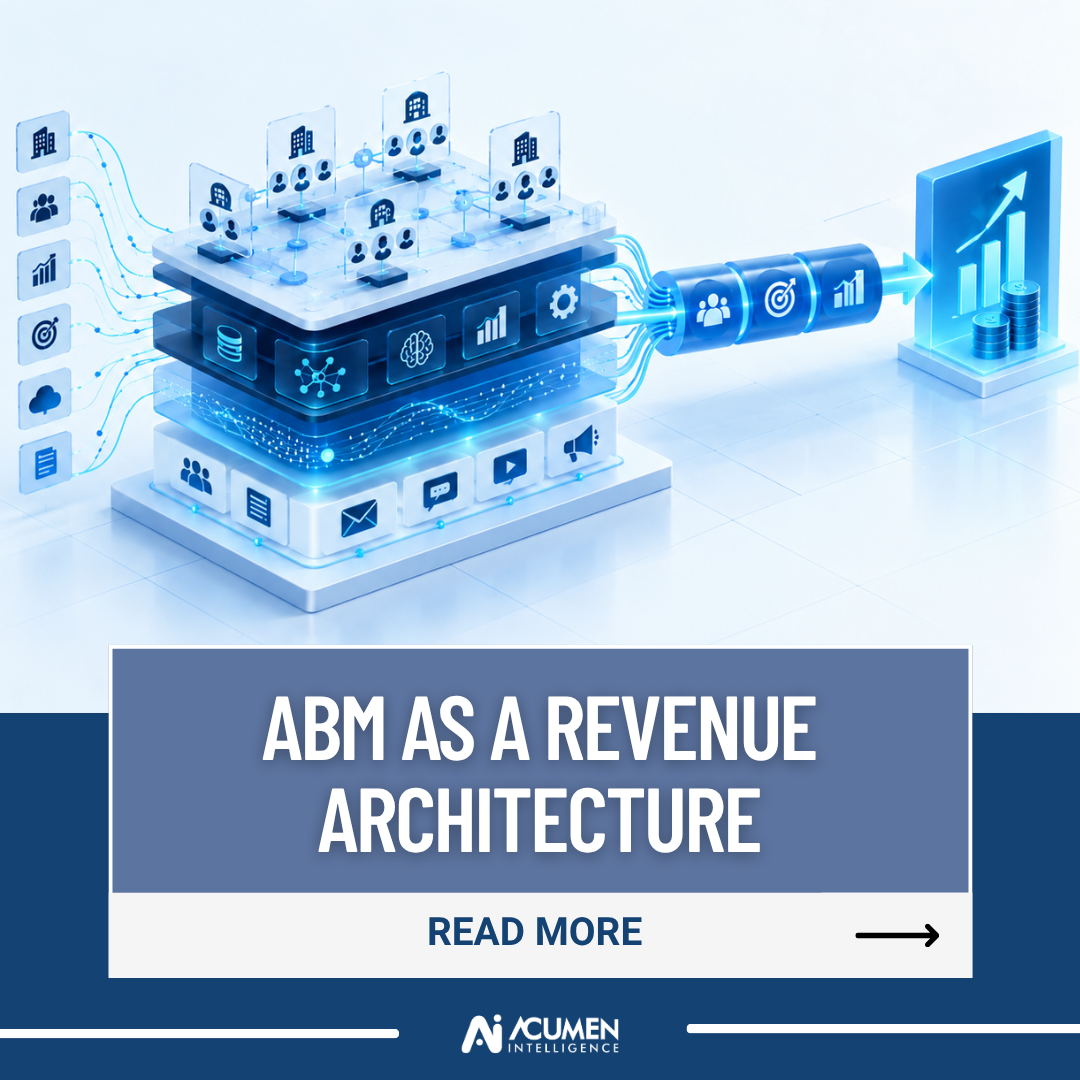
This is where the new enterprise revenue stack is taking shape. It is a connected commercial system built around data intelligence, digital buying signals, account engagement, demand activation, sales follow-up and deal progression. Its purpose is to show where demand is forming, which accounts are moving and where sales action can create impact.

Shift 1: From Campaign Data to AI-Ready Revenue Intelligence
Data volume is no longer the competitive advantage. Most technology-led growth functions already have campaign reports, CRM records, engagement metrics and lead data. The real question is whether that data is clean, connected and commercially useful enough to guide decisions.
As AI and automation become embedded into demand generation, content syndication, lead scoring and sales prioritisation, fragmented data becomes a serious limitation.
Recent research predicts that through 2026, 60% of AI projects unsupported by AI-ready data will be abandoned.
For the new enterprise stack, data must move from passive reporting to active guidance, helping teams identify intent, engaged decision-makers, high-performing content and leads most likely to progress. Campaign data becomes the foundation for sharper targeting and better-informed sales action.
Shift 2: From Individual Lead Capture to Buying-Group Intelligence
Complex technology buying decisions are rarely made by one individual. A single lead may indicate interest, but it does not reveal the full account picture or collective buying movement.
This is critical for enterprise technology, SaaS and digital transformation solutions, where decisions often involve multiple departments and stakeholder concerns.
Research reports that, on average, 13 people are involved in a business buying decision, with 89% of purchases involving two or more departments. A form fill, content download or webinar registration is often only one signal within a wider buying network.
The focus must therefore shift from “Who downloaded the asset?” to “Which account is showing collective buying movement?” The new enterprise stack should reveal decision-makers, influencers, technical and finance stakeholders, while connecting engagement to account-level intent.
Shift 3: From Traditional Nurture to Independent Buyer Evaluation
Enterprise technology buyers are researching more before speaking to sales. Their journeys are increasingly digital and AI-assisted, meaning demand activity can no longer depend only on traditional nurture flows.
Data shows that 67% of B2B buyers prefer a rep-free experience, while 45% used AI during a recent purchase. This shows that buyers are increasingly shaping their own understanding of vendors, solutions and value before sales engagement begins.
Therefore, content is no longer just for awareness, it supports independent buyer evaluation by helping decision-makers compare solutions, understand business impact and build confidence. Content syndication, display advertising, webinars and intent-led engagement help reveal invisible buying activity before sales begins.
Shift 4: From Lead Handover to Deal Momentum
Generating demand is not enough if it does not move into qualified sales engagement. The old model treats marketing and sales as separate stages. The new enterprise revenue stack connects demand signals directly to sales action.
Research highlights that technology and AI can support sales teams through machine-learning-powered lead routing, automated account planning and lead management. This gives sales teams clearer visibility into warming accounts, high-interest topics, priority contacts, ABM opportunities and urgent follow-ups.
Success is not measured only by lead volume, but how effectively demand progresses into meaningful commercial opportunities. The new enterprise stack should accelerate deal movement through sharper timing, stronger account intelligence and relevant sales engagement.
Shift 5: From AI Activity to AI-Powered Revenue Precision
AI adoption is becoming common, so the advantage is no longer simply “using AI”.
Recent research reports that 80% of marketers use AI for content creation and 75% use it for media production. Hence, differentiation comes from better data, sharper targeting and stronger revenue connection.
Another research predicts that by 2028, 90% of B2B buying will be AI-agent intermediated, pushing over $15 trillion of spend through AI agent exchanges. This raises the standard for how technology brands structure content, product information, data signals and demand campaigns.
The Acumen Intelligence Advantage : Turning Data-Backed Demand into Revenue-Ready Engagement
Acumen Intelligence helps technology brands convert data-backed demand into revenue-ready engagement through proven B2B lead generation expertise, data-driven strategies, marketing automation and access to a global network of decision-makers.
Through content syndication, Acumen Intelligence places valuable content in front of relevant decision-makers. Its lead generation services convert market interest into qualified engagement, intent data identifies active research behaviour, events and webinars deepen engagement with interested audiences, and ABM focuses activity around priority accounts and buying groups.
By connecting targeting, engagement and lead outcomes, Acumen Intelligence helps brands turn demand activity into meaningful engagement and revenue-ready opportunities.
Conclusion: The New Stack Is a Connected Commercial System
The new enterprise stack is not about adding more platforms. It is about connecting the systems, data and actions that directly influence revenue. Data must become usable intelligence. Demand must become targeted activation. Buying groups must become visible. AI must be governed around revenue use cases.
The brands that win the next phase of technology-led growth will be those that stop treating data, demand and deals as separate functions, and start operating them as one connected revenue system.