In 2026, display advertising is no longer competing for attention. It is competing for relevance, buying intent, and commercial influence.
For years, display advertising sat in an uncomfortable position within the digital demand ecosystem.
It delivered reach, visibility, and impressions, but it often struggled to prove direct commercial impact. For instance, revenue teams questioned attributions, sales leaders questioned lead quality, and performance marketers shifted investment towards channels that appeared easier to measure against pipeline outcomes.
However, the market has changed.
Quietly, and faster than many organisations realise, display advertising has evolved from a broad-reach awareness channel into something far more strategic: a precision-targeting layer embedded directly into modern demand-generation infrastructure.
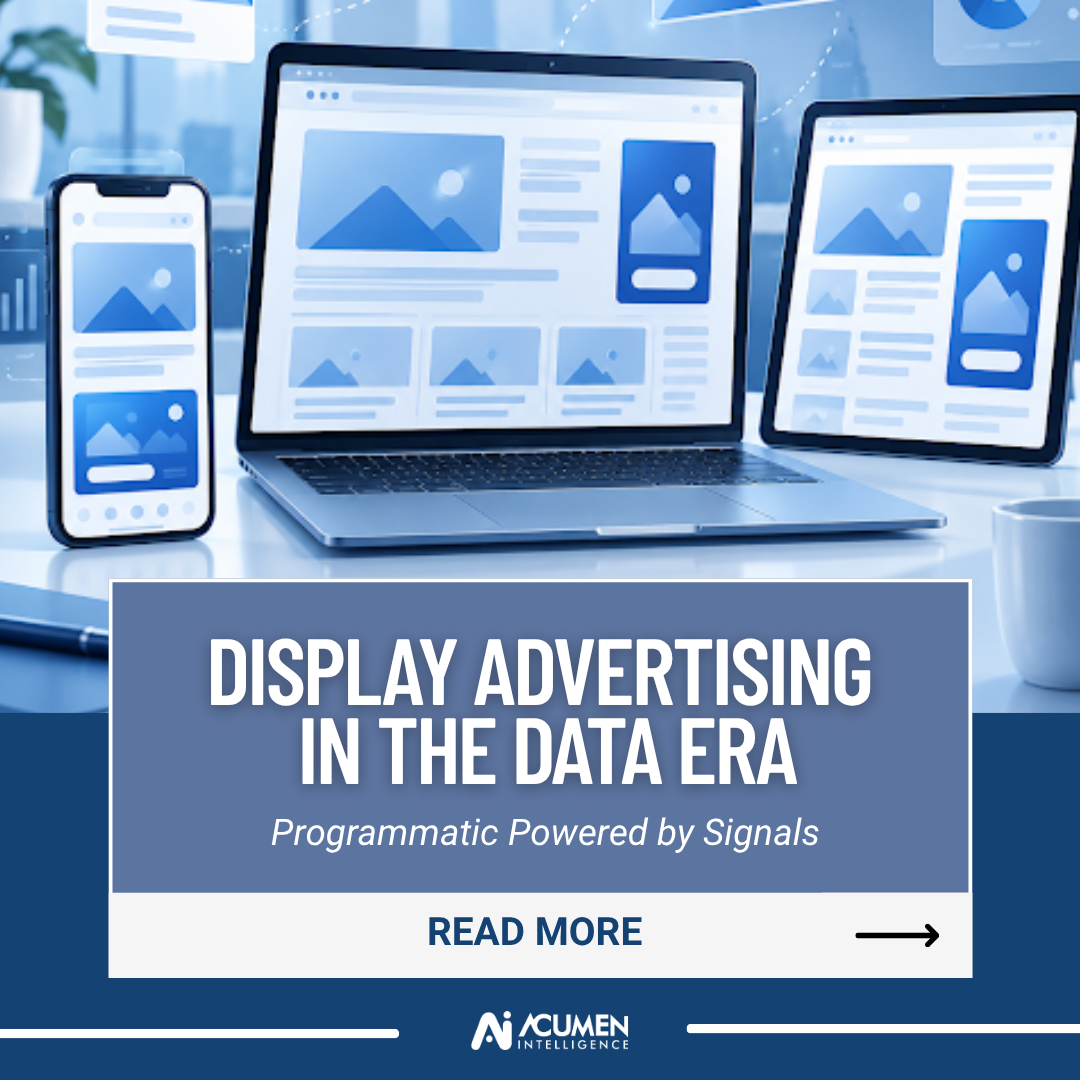
In 2026, the organisations seeing the strongest results from display are not using it to “push adverts”. They are using it to orchestrate visibility across high-value accounts, influence buying-group engagement, reinforce intent-driven journeys, and create sustained digital presence throughout increasingly complex purchasing cycles.
Therefore, the difference is not the format. The difference is the intelligence behind the delivery.
Precision Now Beats Volume
Modern B2B buying journeys no longer move in straight lines.
For instance, decision-makers consume information across analyst reports, webinars, technology publications, peer communities, LinkedIn conversations, AI-powered research tools, review platforms, and third-party content ecosystems, often long before a sales conversation begins.
Hence, that shift has fundamentally changed how display advertising creates value.
This is where data-driven targeting is reshaping the channel entirely.
Today’s revenue-focused organisations are integrating:
- Intent data
- Behavioural analytics
- Buying-group engagement signals
- Account-level activity tracking
- AI-driven segmentation
- Predictive optimisation models
- First-party data environments
into display programmes designed to support measurable pipeline progression rather than passive awareness.
Therefore, the result is a far more intelligent advertising framework where display becomes part of a coordinated digital engagement strategy, such as supporting ABM initiatives, account nurturing, retargeting, buying-stage progression, and multi-touch influence across priority accounts.
Moreover, according to research, AI-powered personalisation and predictive audience engagement are becoming central to how modern marketing organisations execute customer acquisition and retention strategies. That shift is directly influencing how digital advertising platforms optimise relevance, timing, and engagement delivery in real time.

AI Is Turning Display into a Smarter Engagement Layer
Artificial intelligence is accelerating this transformation even further.
Display advertising is no longer static media placement. It is becoming a dynamic optimisation environment that continuously adapts based on behavioural signals and engagement performance.
For instance, recent research in AI marketing trends shows that marketers are increasingly using AI to improve campaign optimisation, targeting precision, personalisation, and operational efficiency at scale.
That matters because the competitive battleground in 2026 is no longer visibility alone; It is attention efficiency.
Therefore, revenue teams are under pressure to reduce wasted spend, improve engagement quality, accelerate pipeline velocity, and demonstrate stronger alignment between marketing execution and commercial outcomes.
However, AI-driven display ecosystems now allow organisations to refine:
- Audience prioritisation
- Creative sequencing
- Bid optimisation
- Engagement timing
- Industry-specific messaging
- Conversion probability modelling
based on live behavioural intelligence.
In practical terms, display advertising is becoming less about media buying and more about activating audience intelligence.
And that distinction matters.
Because in today’s market, poorly targeted reach is not simply inefficient; it is commercially expensive.
The Real Shift Is Buying-Group Precision
One of the most overlooked developments in digital demand generation is the growing importance of buying-group visibility.
For instance, technology purchasing decisions in 2026 rarely involve a single stakeholder. Most enterprise buying journeys now involve multiple decision-makers across procurement, finance, operations, IT, cybersecurity, compliance, and executive leadership.
That creates a major challenge for modern revenue teams, because how do you maintain consistent visibility across fragmented, self-directed buying journeys without overwhelming audiences with outbound activity?
Increasingly, display advertising is becoming part of the answer.
When powered by account intelligence and intent-led targeting, display allows organisations to maintain a strategic presence across entire buying groups throughout extended decision cycles.
This is especially valuable in enterprise technology and SaaS environments where consideration periods are longer, evaluation processes are more complex, and competitive noise is significantly higher.
Furthermore, according to a 2025 state of marketing insights report, personalised engagement continues to outperform generic campaign approaches in both engagement and commercial performance metrics.
That reinforces a broader market reality:
Precision engagement is outperforming broad-based digital reach.

Why This Matters for Revenue Strategy in 2026
The future of display advertising will not belong to the organisations with the biggest media budgets.
It will belong to the organisations with the strongest data ecosystems.
Hence, the resurgence of display advertising is happening because the infrastructure surrounding it has evolved:
- Better intent intelligence
- Cleaner first-party data environments
- Stronger AI optimisation capabilities
- More accurate attribution frameworks
- Improved audience segmentation
- Real-time engagement analytics
- Smarter account prioritisation
Therefore, display is no longer operating as an isolated awareness channel sitting outside the revenue engine; it is becoming an integrated component of modern pipeline acceleration strategy.
And for organisations operating in competitive digital markets, that evolution creates a major opportunity.
Because while many businesses still view display through the lens of impressions and clicks, leading revenue teams are already using it to influence buying behaviour, strengthen account penetration, reinforce market positioning, and improve commercial visibility across the full demand lifecycle.

The Acumen Intelligence Advantage
At Acumen Intelligence, we believe modern display advertising performs best when it operates inside a wider data-driven demand generation ecosystem.
Effective digital engagement today requires far more than media execution. It requires accurate audience intelligence, high-quality data environments, strategic segmentation, and coordinated engagement strategies aligned to real commercial objectives.
Through intent-led targeting, demand generation programmes, content syndication, marketing automation, and precision-focused audience engagement strategies, Acumen Intelligence helps organisations transform digital visibility into measurable pipeline impact.
Because in 2026, attention alone is no longer the objective.
Precision is.
Connect with the Acumen Intelligence Business Development team to build precision-led demand generation and display advertising programmes that use audience intelligence, intent data, content syndication, and marketing automation to engage the right decision-makers and drive measurable pipeline impact.